The Churer Tor in the Press
Excerpts from publications
Vorarlberger Nachrichten, 17 July 2024
An interesting permanent exhibition has opened at the Churer Tor. Of the four medieval gates that once formed part of Feldkirch’s city walls, only the Churer Tor and the Mühletor remain ...
by City Archivist Mag. Christoph Volaucnik - Feldkirch aktuell /2.2002
Like all medieval towns, old Feldkirch was surrounded by a ring of fortifications—comprising city walls, a moat, and city towers and gates—until the first half of the 19th century. Of the original four city gates, the Churer Gate and the Mühletor have survived to this day.
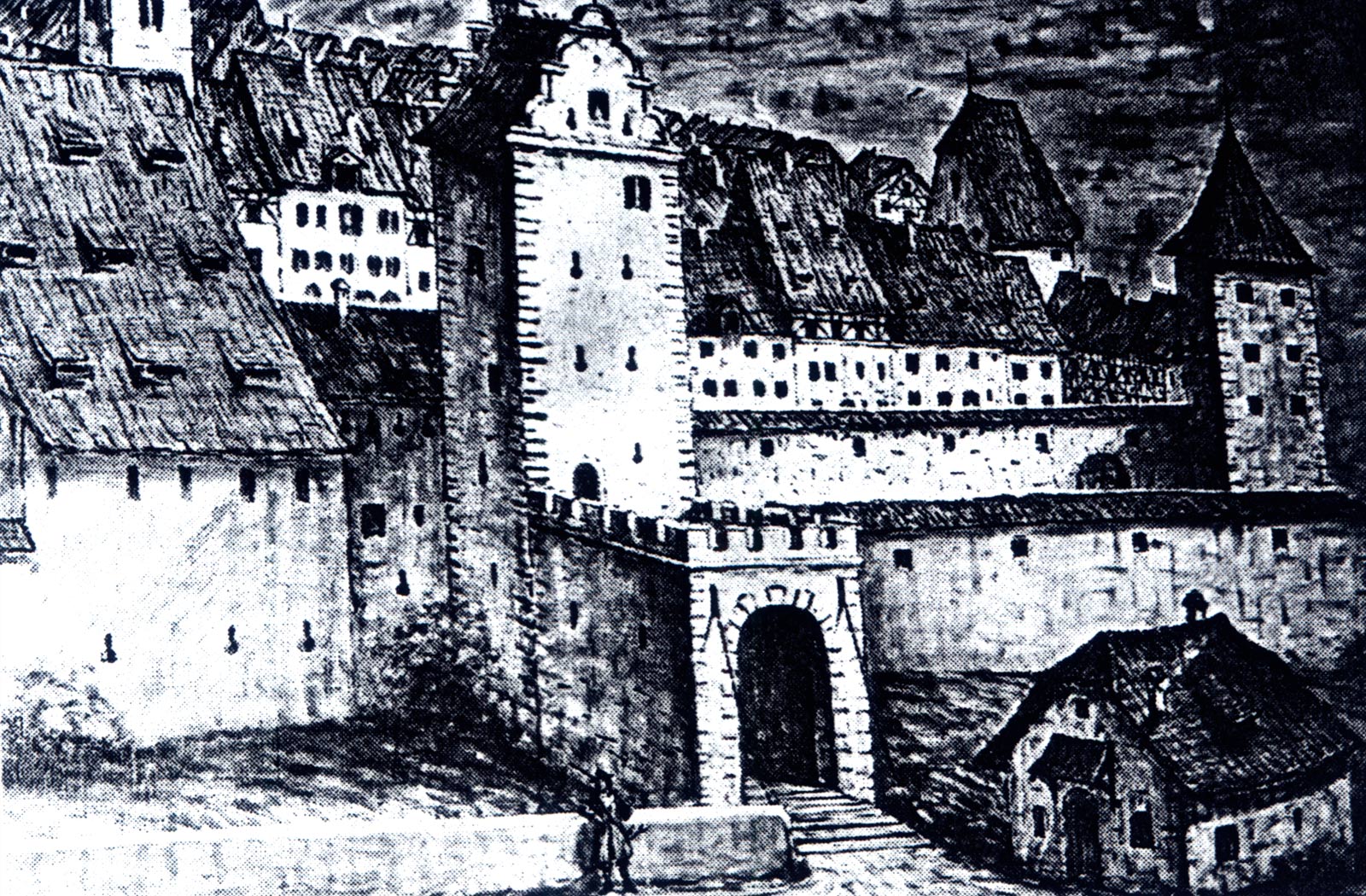 The Churer Gate in particular, which has recently undergone extensive restoration, is impressive for its sheer size, standing six storeys high. Both the Mühle Gate and the Churer Gate still clearly display the defensive features that were once part of their design. The masonry features fixtures for hanging beams, which were intended to prevent the city gate from being broken open. The mighty door hinges, weathered by the ravages of time, give an impression of the size of the doors that once hung here. The embrasures also point to the gates’ former military significance.
The Bregenz Gate fell victim to the modernisation efforts of the 19th century in 1836, and the Bludenz Gate in 1870. The Chur Gate came into private ownership in 1824, but lost its crenellated porch after 1826 when the Hirschgraben was filled in.
The Churer Gate in particular, which has recently undergone extensive restoration, is impressive for its sheer size, standing six storeys high. Both the Mühle Gate and the Churer Gate still clearly display the defensive features that were once part of their design. The masonry features fixtures for hanging beams, which were intended to prevent the city gate from being broken open. The mighty door hinges, weathered by the ravages of time, give an impression of the size of the doors that once hung here. The embrasures also point to the gates’ former military significance.
The Bregenz Gate fell victim to the modernisation efforts of the 19th century in 1836, and the Bludenz Gate in 1870. The Chur Gate came into private ownership in 1824, but lost its crenellated porch after 1826 when the Hirschgraben was filled in.
The names or proper names of these gates have changed over the centuries. The Mühletor, whose name derives from the neighbouring town mill – now a power station – was known as St. Lenhart Gate in the 16th and 17th centuries. This name referred to St. Leonhard’s Church, situated in front of the gate. In 1712, it is documented as the Mühletor, and later also as the Sautor. This was likely derived from the pig market held in the immediate vicinity. In 1883, a document mentions the name Fabrikstor, due to the presence of the Getzner, Mutter & Cie factory there.
The Bludenz Gate, situated at the northernmost end of the New Town, known as the Gaiszipfel, was called the Schultor until the end of the 18th century, as the Latin School and the German School were located in its vicinity. The Bregenzertor, situated between the parish church of St. Nikolaus and the Hotel Post, was known for a long time as the Sankt Nikolaustor.
Until 1615, what is now known as the Churer Tor was called the Hewerstor, a name that probably derives from the Hewers family. The name Salztor was first used in 1618. This name comes from the neighbouring Salzstadel, where salt delivered from Tyrol was stored. The name Illtor was used for the Wassertor, situated directly next to the water tower, at the beginning of the 16th century. One can see how the names of buildings, as well as field names, have adapted to changing external conditions over the centuries. It appears that the names commonly used today for the city gates – and indeed for the towers – only came into use in the 19th century.
The city gates were closed during the night and only opened again at dawn. However, it was not the gatekeeper who was responsible for opening and closing these gates, but gatekeepers appointed every six months. For each gate, two people were ‘lent’ the keys by the city....
The gatekeeper at the Chur Gate had a particularly important role. He was responsible for collecting customs duties and tolls. A precise tariff determined how much of these import duties went to the sovereign and how much to the town. For this task, he received a salary or remuneration from both the town and the imperial customs officer. In 1789, the district office demanded a say in the appointment of the gatekeeper at the Salztor, as this was a position of trust.
The city gates presumably served only partly as official residences. The gatekeeper of the Chur Gate lived in a gatekeeper’s house situated on the plot of land now occupied by the Volksbank. The gate itself housed the official residence of the salt storekeeper, who was responsible for managing business at the salt storehouse. There was also a prison within the Chur Gate...
The city gates and towers of Feldkirch, as imposing monuments to a city with a rich history, deserve greater attention. They should not merely be given a cursory glance whilst passing by; their history also merits a thorough historical examination.
Vorarlberg Online VOL.AT, 30 March 2011
Like all medieval towns, old Feldkirch was surrounded by a ring of fortifications—comprising city walls, a moat, and city towers and gates—until the first half of the 19th century. Of the original five city gates, the Churer Gate and the Mühle Gate have survived to this day. The Churer Gate, in particular, with its six storeys and extensive restoration, is impressive for its sheer size ...