The city gate "Churer Tor" in Feldkirch
Built before 1270, completely rebuilt in 1491.
From the Middle Ages to the present day
The name ‘Feldkirichun’ in the Rhaetian Imperial Land Register – a register of property dating from 842 AD – was derived from one of the churches in the field and originally referred to the settlement now known as Altenstadt. In 1218, the new Feldkirch was first mentioned in a document as a town.
In the early days of the town of Feldkirch, the Marktstraße emerged as the centre, with a parallel street and two cross streets, surrounded by a wall. To the west, where Kreuzgasse and Montfortgasse meet today, stood the predecessor of the Churer Tor. From 1379, the area up to the River Ill was developed and the ‘suburb’ was enclosed by a wall. To the north-west, at its present location, the Churer Tor now provided access to the town.
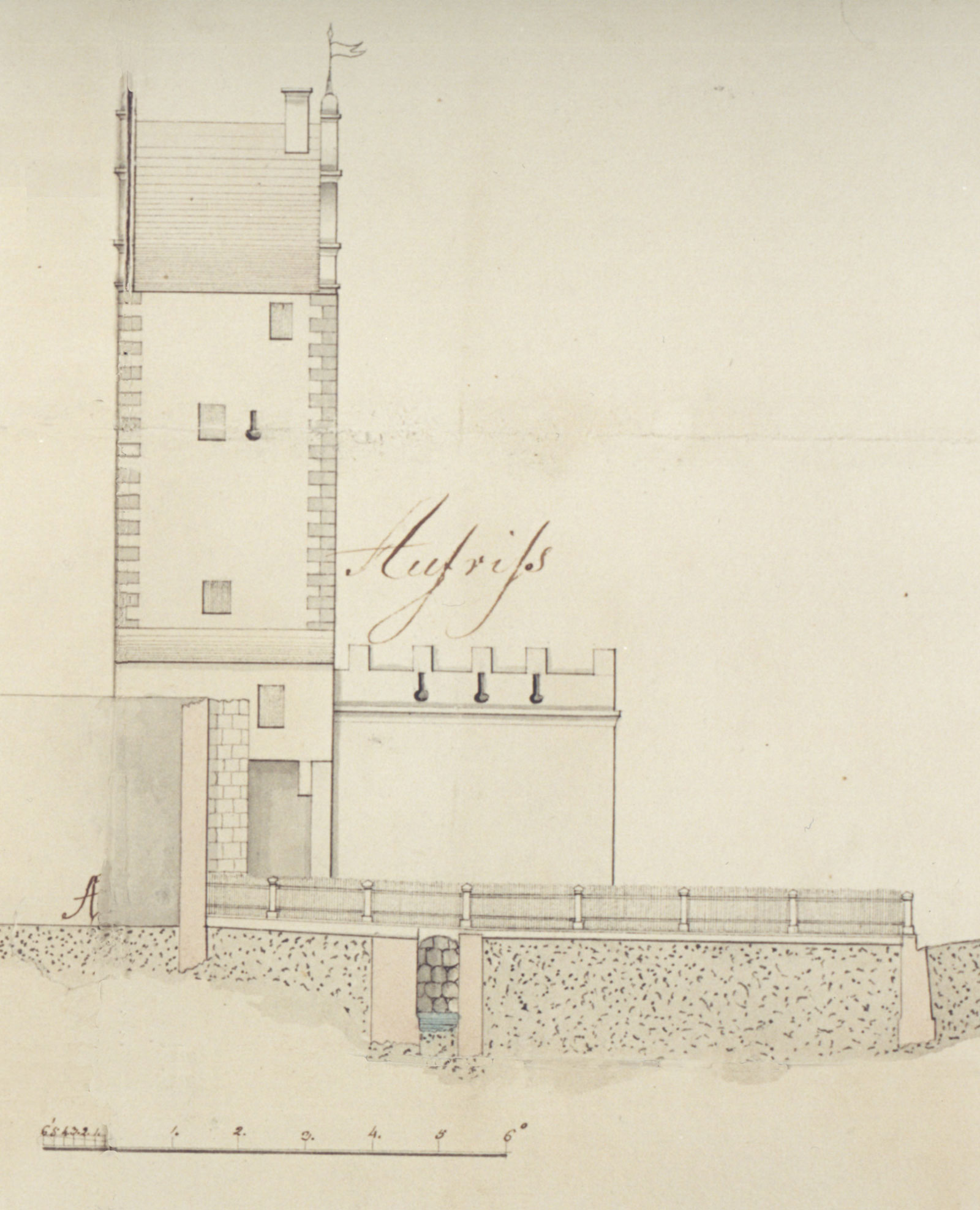
As part of the re-fortification of the town of Feldkirch, in view of the impending war with Switzerland, the gate was completely rebuilt in 1491 and erected as a four-storey artillery and gate tower. Master builder Hanns Sturn, who built the cathedral and the Katzenturm, was presumably responsible for the conversion of the Chur Gate.
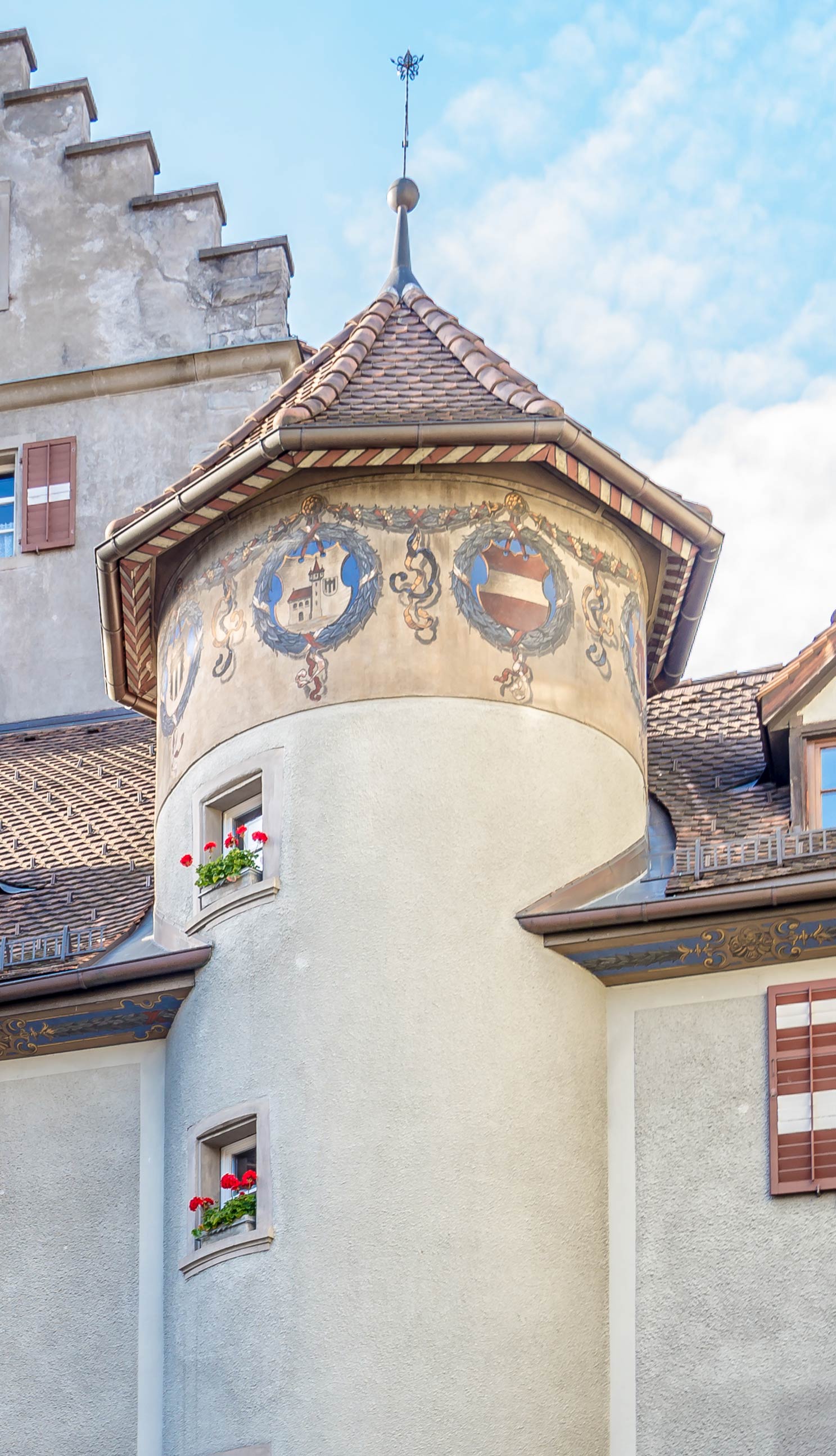
In 1591, the tower was raised to six storeys and given its present form, featuring a stepped gable. The Chur Gate was given a forecourt with a crenellated wall and a gateway. A three-storey porch was added to the tower on the side facing the town, which continues along the town wall to the right. A round stair tower is also incorporated there. This bears the Feldkirch coat of arms in a scroll cartouche bearing the date 1591, the year in which the forecourt was also built.
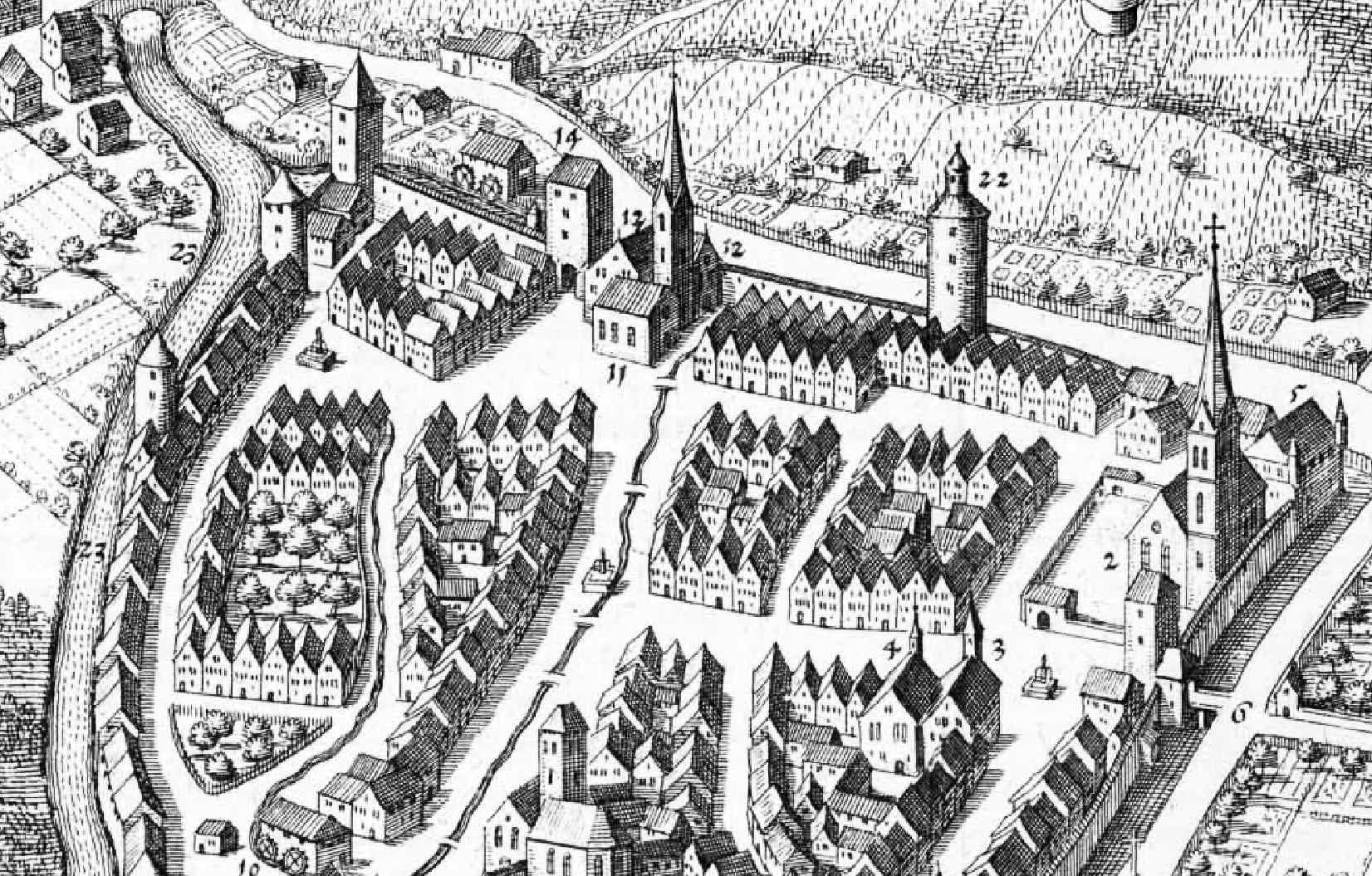
In the past, the Chur Gate was also known as the Hewers Gate and the Salztor. The name Salztor, which came into use after 1615, derives from the neighbouring salt storehouse, where salt from Hall was stored and which was demolished in 1905. The Chur Gate also housed the official residence of the salt master; the gatekeeper himself lived in a small house nearby.
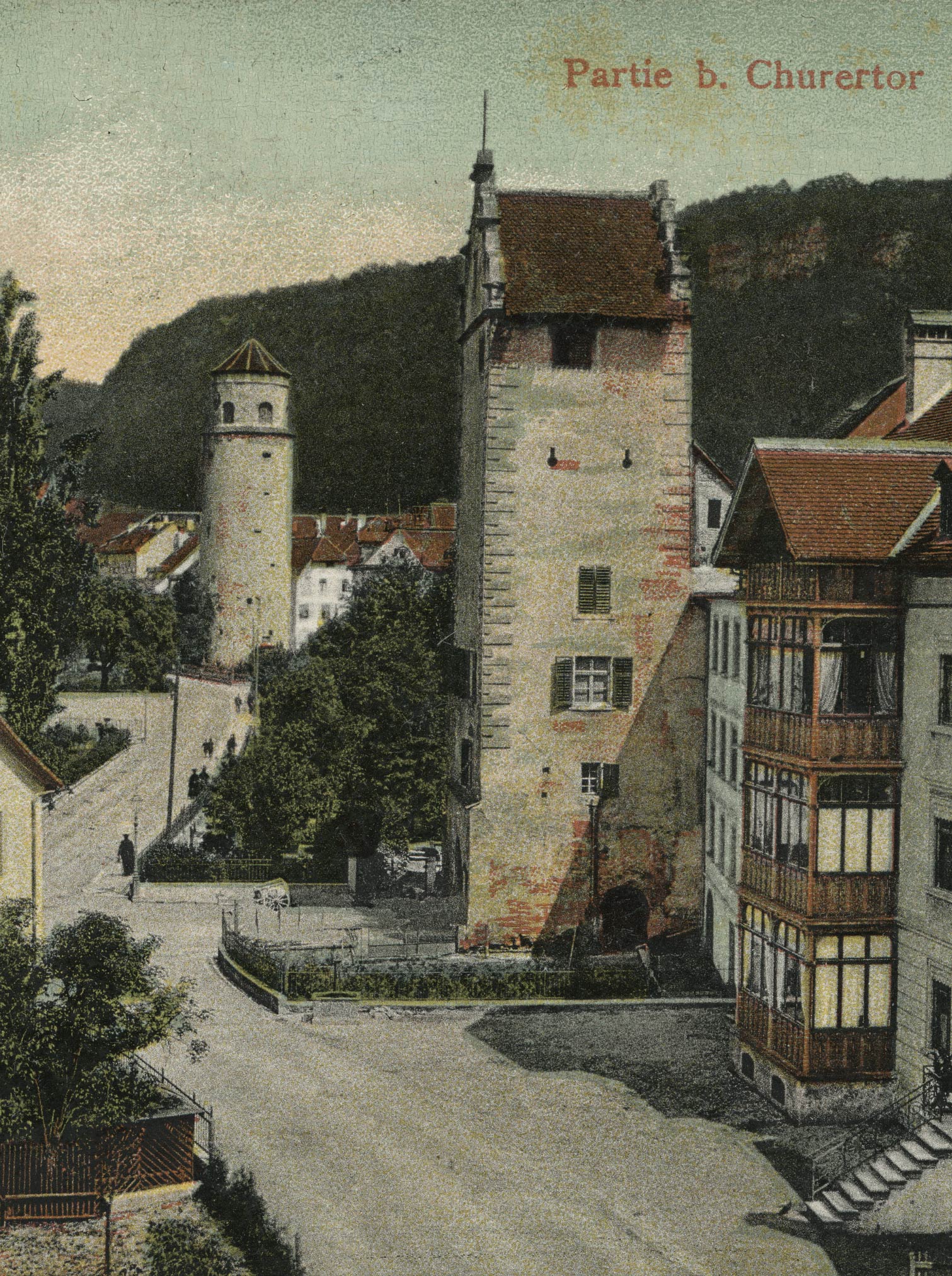
Until the early 19th century, the city gates were opened by the gatekeepers at daybreak and closed when the Ave Maria bells rang at 6 pm. A final order to close the gates, presumably due to itinerant beggars, has been preserved from the year 1817. As part of the levelling of the city moats in 1826, the outer bailey of the Chur Gate was demolished.
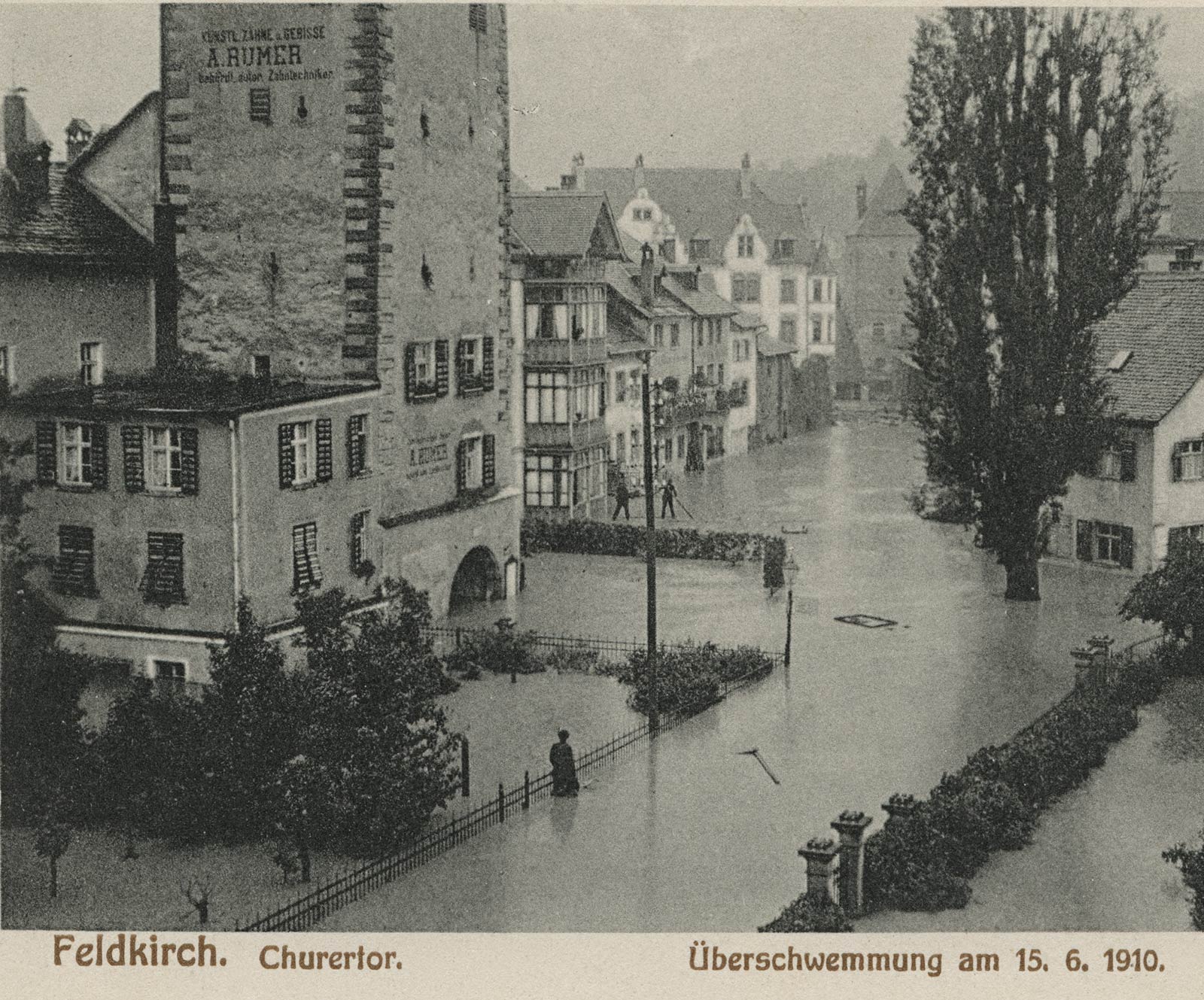
On 15 June 1910, the River Ill burst its banks, causing one of the worst floods in Feldkirch.
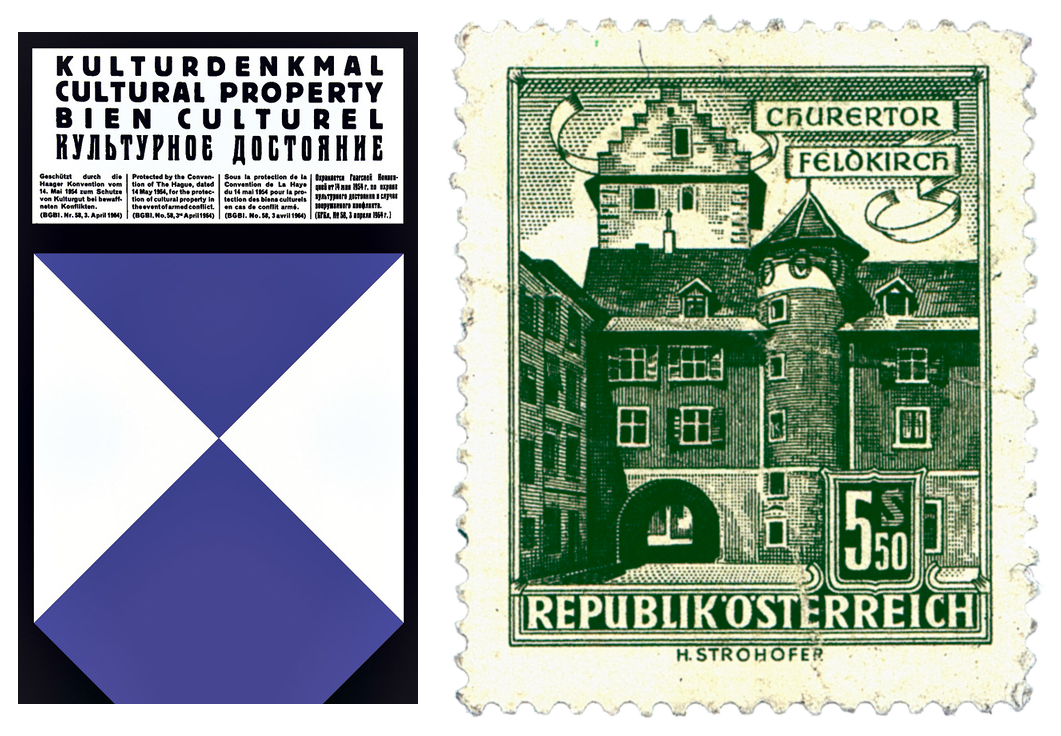
On 28 March 1961, the Churer Tor became the first building in Feldkirch to be listed as a historic monument. The previous year had seen the issue of an Austrian stamp with a face value of ATS 5.50, featuring the Churer Tor.
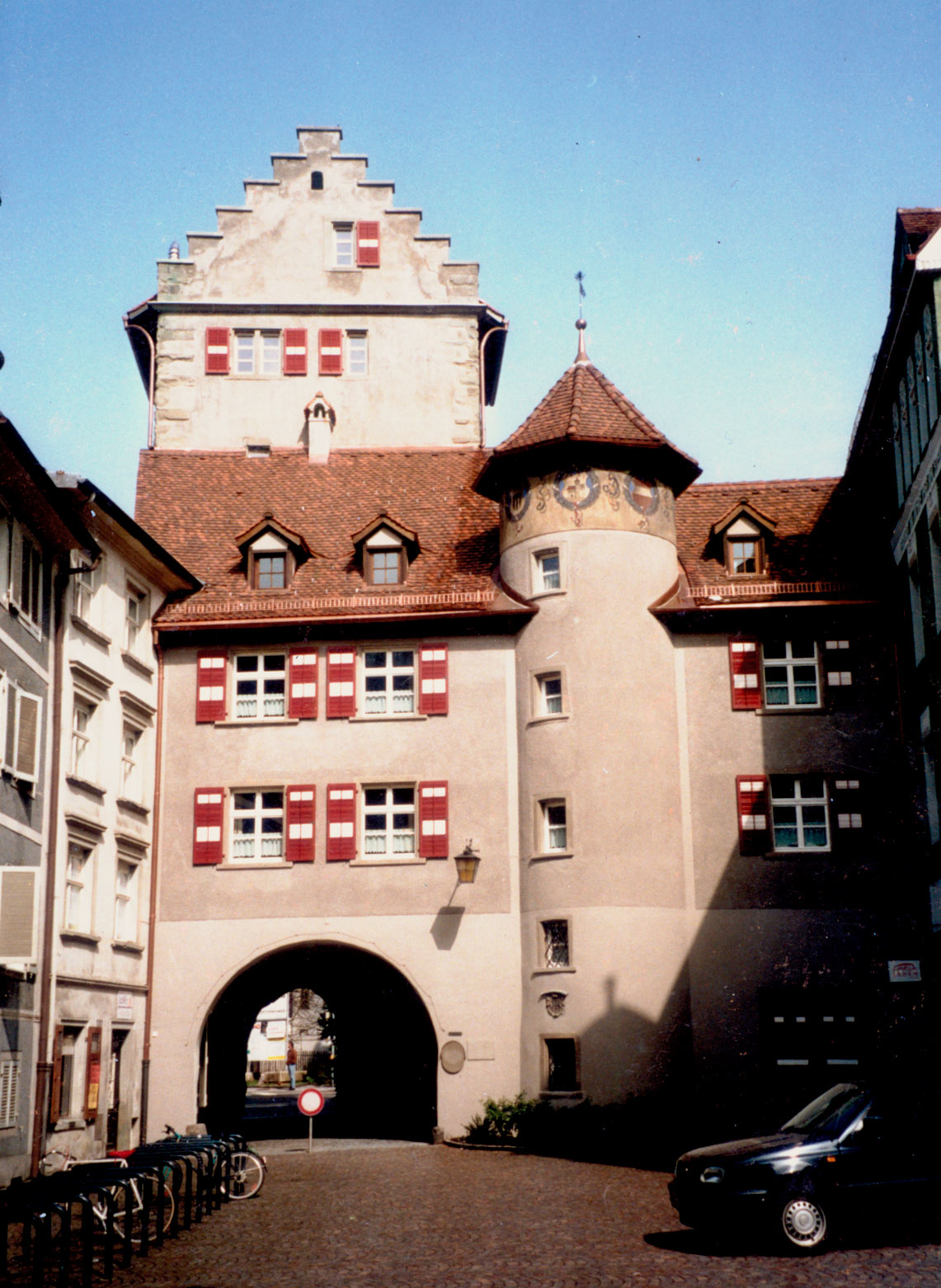
Under the supervision of Egon Cavada, Head of the Building Department of the City of Feldkirch, a comprehensive restoration and external refurbishment of the Chur Gate is currently underway.
The Chur Gate in the past
The town fortifications consisted of an inner, higher wall, a moat and an outer wall. The inner town wall, a section of which can still be seen in a photograph near house no. 13, was 1.20 m thick at that point (including a loophole with a stone lintel). The height of the city wall facing the Hirschgraben is not precisely known. Inside the Katzenturm, the wall on the town-facing side is straight on the ground floor and first floor, as the round tower was built onto the city wall, which provides a clue as to the height of the city wall. On Entenbachgasse, there is a section of city wall that is 7 m high. At the Churer Tor, the embrasures on the third floor of the extension facing the field indicate that this section formed part of the outer wall of the city wall. It is not clear whether this wall was part of the city wall with a battlemented walkway or an extended section of the tower’s defences.
The lower, outer city wall served as additional protection: an enemy who managed to penetrate the ‘Zwinger’ found little room to manoeuvre in the confined space, whilst the defenders behind the main city wall could easily engage the enemy from above. In 2012, during excavations for the Montforthaus, the Zwinger wall was archaeologically confirmed.
The moat was situated between the two walls and was filled with water from the Metzgerbach and Gerberbach streams in times of danger.
The Katzenturm provides evidence of the course of the battlement walk: on the second floor there is a round-arched door which led to the battlement walk of the city wall (now bricked up). The course of the battlement walk at the Chur Gate has not yet been clarified. On the field-side extension above the third floor, there was a wooden door, which can still be seen in the oldest photograph of the field side of the Chur Gate. Whether it led to the battlement walk remains to be clarified.
The gatekeeper of the Chur Gate lived in a gatekeeper’s house situated on the site of today’s Volksbank. Within the gate itself was the official residence of the salt housekeeper, who was responsible for managing business at the salt storehouse. There was also a prison within the Chur Gate.
There is no record in the accounts of chroniclers or in archive entries of any direct military engagements taking place at the city walls or towers of Feldkirch.
Before the outbreak of the Swabian War in 1499, defensive capabilities within the Swabian League were expanded; against this backdrop, the Chur Gate was also rebuilt entirely from stone. However, the Swabian War was not fought directly in Feldkirch in the border region, but rather in the Battle of Frastanz on 20 April 1499 between troops of the Swiss Confederation and the Swabian League, and in the Battle of Dornach on 22 July 1499. Feldkirch was regarded as a ‘bulwark that, unlike the surrounding area, could not be conquered by the Swiss’ (Frey, 1958). The victorious Confederates concluded the Peace of Basel with Emperor Maximilian on 22 September 1499.
In the 17th century, during the Thirty Years’ War, Feldkirch also faced the threat of war when, in January 1647, the Swedish army, led by General Wrangel, advanced towards Bregenz from the Allgäu region.
With the defence plan of 27 December 1646, the Feldkirch town council originally intended to defend the town. From the defence plan, it is possible to reconstruct the deployment of soldiers and officers at the town gates, towers, the roundhouses in front of the towers, the town walls and the fortifications, together with the weapons available in Feldkirch. Paul Furtenbach is named as the officer and commander for the Salzthor. A total of around 260 men were allocated to the defence. They had at their disposal 111 double-barrelled arquebuses, 18 cannons – so-called ‘pieces’ – most of which were mounted on wheels, as well as two bangers. ‘Doppelhaggen’ referred to firearms two metres long and weighing 30 kilograms, which were placed on trestles for firing. Two men were required to operate this weapon. A ‘Kammerstück mit Haggel’ was to be set up on the market square, the main guard square (Corp de Guardia).
At the largest town tower, the Katzenturm, seven pieces on wheels and 22 double-barrelled muskets were to be deployed. Twelve men were to be stationed in the tower area to man the cannons and muskets. However, the defence plan was never put into action, as Feldkirch surrendered without a fight and the population had fled to Bendern and into neutral Switzerland.
In times of war, the city gates were guarded more closely by the citizen militia. During the military unrest of 1712 in the Swiss Rhine Valley and Toggenburg, Feldkirch, as a border town, decided to step up the city’s defences. More guards were posted outside the gate; it was only after the peace treaty was signed in August 1712 that their numbers were halved.
By the end of the 18th century, the fortifications had finally lost their protective function against firearms. This was particularly evident during the Coalition Wars. When the French commander André Massena marched with his troops from Liechtenstein towards Feldkirch in March 1799, the Vorarlberg troops did not retreat behind the city walls, but instead confronted the advancing French at the Letze, Margarethe and Veitskapf, which, due to their geographical features, offered greater protection than the city walls.
In 1387, the Salzstadel was built at the Churer Tor to facilitate the onward transport of salt into Switzerland. In this way, salt and numerous other goods made their way out into the world through Feldkirch’s city gates.
The cartage system was important for Feldkirch. Whilst today a haulier can drive their lorry (almost) unhindered from the North Cape to Sicily, in the past transport routes were organised so that a cart could carry goods in a single day. In the evening, it would reach an unloading station, known as a ‘Zuschg, Sust’. There, the goods were unloaded and stored, and the next day another cart driver could set off on the next leg of the journey – from Feldkirch’s perspective, towards Maienfeld.
Near the Chur Gate stood a warehouse, the Salzstadel, used for storing salt from Hall in Tyrol. This salt, delivered to Feldkirch by packhorses, was then transported on to Switzerland from here. In the area of what is now Marokkanergasse stood a warehouse, commonly known as the Dogana, where goods were stored overnight.
What goods were transported through Feldkirch at that time, a stop on the important long-distance trade route from Germany to Italy? From Germany, specifically Swabia, came linen cloth, leather, ironware and, above all, copper goods. These copper products are, incidentally, already mentioned in the town charter of 1399. From Italy came luxury goods, silk scarves, spices and, as a delicacy, rice from Lombardy. Horses were also an important export, driven to Italy.
In 1904, the 500-year-old salt storehouse was demolished to make way for much-needed housing in the town.
The following article appeared in the *Vorarlberger Volksfreund* on 4 May 1904:
“At last, work is beginning on the construction of workers’ housing in Feldkirch. The salt storehouse next to the Chur Gate is to be demolished for this purpose, and a building in Felsenau is to be converted into flats. Truly, it is not a moment too soon, when one considers the wretched, expensive dwellings in so many buildings, which are a complete mockery of every fire, health and public decency regulation and which, unfortunately, are by no means isolated cases.”